

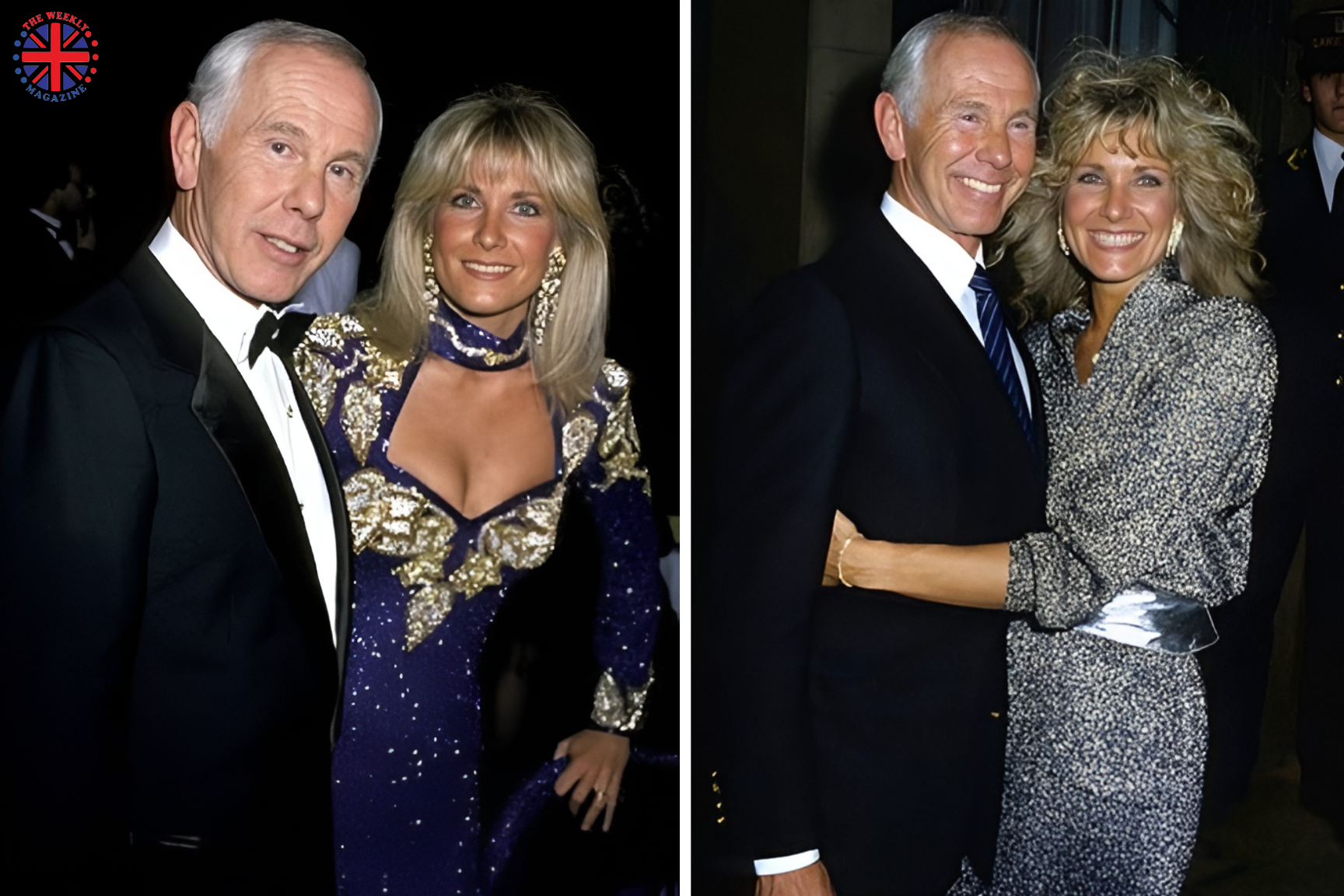
Alexis Maas has been quiet for so long that the internet has started speaking for her.
Search her name and a biography assembles itself in seconds. On one site she is a former Wall Street executive. On another she is an actress who left a hit series. A third calls her Johnny Carson’s “ex-wife,” though Carson died her husband. One page supplies direct quotations in her voice, warm and reflective, with no interview attached. Her net worth floats past $300 million. Her birth year shifts from page to page. None of them shows its work.
Carson left the opposite kind of record. For thirty years he sat behind the desk on The Tonight Show, and the applause, the monologue and the beat of silence before a punchline made him a fixture in American living rooms. He survives in clips, ratings, books and the memory of everyone who ever stayed up past bedtime to watch.
Maas married him in 1987 and was still his wife on the day he died. What she left in public view would fit on an index card. A private wedding at his Malibu beach house, confirmed through his spokesman. The sale of the oceanfront compound two years after his death. After that, as far as any public record shows, very little.
This is a story about that gap. Where is Alexis Maas today? What did she inherit? How much of what is printed about her traces back to anything at all? What follows tracks the paper trail—a marriage notice, a pair of property sales, a charity’s tax return—and marks the spot where the paper stops.
Before the money, there is the marriage.
The Malibu Illusion & The 18-Year Romance
The popular version of this marriage plays like a postcard: a famous man, a beach, a house above the Pacific. The postcard is genuine. What it lacks is anything written on the back. Contemporary reporting preserved the dates and kept the feelings to itself, and later biographies, short on feelings to quote, have supplied their own.
A Meeting on the Beach, a Wedding Behind Closed Doors
Begin with what the record holds. Johnny Carson and Alexis Maas were married on June 20, 1987, at his beach home in Malibu. The Los Angeles Times reported the wedding on June 29 under the headline “Johnny Carson Weds 4th Time”, with the date, the location and the couple’s ages. The ceremony was private, and the marriage was confirmed through Carson’s spokesman. The New York Times carried its own notice on June 30. It was Carson’s fourth marriage and, by the reports, Maas’s first.
How they met is a thinner story. Accounts put the first encounter on a beach near his home around 1985, the year his third marriage ended. It is a detail with the cadence of legend and about the same level of sourcing.
What can a private wedding tell us? That it was held privately. Everything romantic stacked on top of that fact is construction, and the internet has built tall.
The Age Difference—and What It Does Not Tell Us
Carson was born on October 23, 1925. Maas’s birth year is most often given as 1952, which puts about 26 or 27 years between them, depending on a birthday no reliable source pins down. At the wedding Carson was 61. Maas, if 1952 is right, was about 35, and this year she would be 73 or 74.
If. At least one site gives 1956. A specific birthday and birthplace circulate, copied from page to page without a document behind them. The pattern is familiar. When a person leaves a thin record, the few details that exist get repeated until repetition hardens them into fact. Any answer to the question of Alexis Maas’s age should carry that if.
None of the arithmetic describes the marriage. A gap in years is a number, and numbers invite plots. Nothing in the reporting reviewed records either spouse saying how they regarded the difference, so this account will not invent it for them.
Life at Point Dume
The house is the one part of this story anyone can see. The Johnny Carson Malibu mansion is an oceanfront compound of about four acres on a bluff at Point Dume. Real-estate coverage describes a modernist house of glass and wood, designed by architect Ed Niles in 1978 and organized around an indoor arboretum. The main residence runs about 7,100 square feet and has two bedrooms, with a separate guesthouse. Carson reportedly bought the property in 1984 for about $9.5 million. Architectural Digest’s report on the compound supplies the architectural context.
The house became a celebrity address. Maas appears in its history as an owner and, later, a seller, not as the hostess of any documented parade of guests. That gap between the property’s reputation and the record around her matters. Hollywood’s famous houses tend to come with famous parties. This one comes with a floor plan, a price history and one private wedding.
It matters to this story for a plainer reason, too: it is the clearest physical link between the couple’s private life and Carson’s public legacy. It is also where the paper trail first thickens.
Eighteen Years Together, Until January 2005
The marriage ran from June 1987 until January 23, 2005, the day Carson died: seventeen years and seven months, rounded up by custom to eighteen.
Some accounts treat it as a retirement marriage. For its first five years it was nothing of the kind. Carson was still hosting The Tonight Show when they wed, and he signed off in 1992. The marriage therefore had two parts: a little under five years alongside the nightly grind, then nearly thirteen away from it. No children are reported from the marriage.
Beyond those facts, the record goes quiet in the way that matters. There are no reliable accounts of their routines, their quarrels or their private jokes, and no one should feel entitled to invent them. Public facts end where private history begins.
Carson died at 79, of emphysema. His death changed Maas’s relationship to the public record. After it, the questions concern a house, a fortune and a foundation.
Inheriting a Legacy, Choosing Anonymity
Money tends to make people legible. Estates move through courts, property changes hands in public registers, charities file tax returns. By that logic Carson’s death should have made his widow easy to read. It did not. The documents say a good deal about a house and a foundation and almost nothing about her, and the second verb in this chapter’s title is a hypothesis, not a finding.
What Can Be Established About the Fortune?
Start by pulling apart three things that online accounts fuse: Carson’s wealth, Maas’s inheritance and the charitable trust.
Estimates of the first run wide. Sites quote several hundred million dollars, and a figure near $450 million recurs. None comes from an audited public accounting, because none exists. When The Smoking Gun reported on Carson’s foundation in 2010, it noted flatly that “There has never been a public accounting of Carson’s estate.” Outside the family and its lawyers, nobody can say what the total was, who the beneficiaries were or what share any single transfer represented.
The second item, what Maas personally received, is where internet confidence peaks. Biography and celebrity-wealth pages assign her $144 million or $150 million. Those Alexis Maas inheritance figures point to no probate filing, and the net-worth searches that follow return a flat $300 million or more. Carson was survived by Maas and by two sons from his first marriage, so “the inheritance” was never a single handoff between two parties, and who received what is a question the public record does not answer. One 2026 explainer, alone among the pages reviewed, lists her net worth as “not publicly established.” That is the honest sentence.
A shortcut tempts: take the large online estimate of Carson’s wealth, subtract the foundation’s bequest, call the remainder hers. It looks like accounting. It is arithmetic on a guess. The estimate was never audited, the bequest came from a trust that may not map onto “the estate” at all, and no document says where any remainder went. The answer would be tidy and unfounded.
The Malibu Mansion’s $46 Million Exit
Of everything in this story, the sale of the house is the best documented. Carson died in 2005 and the property passed to his widow, according to later real-estate coverage. In 2007 Maas sold the compound to film producer Sidney Kimmel and his wife, Caroline, for a reported $46 million, nearly five times what Carson was said to have paid in 1984. Realtor.com’s report on the former Carson estate follows the house from that sale to the present.
Keep the chronology straight, because online accounts routinely scramble it. The Kimmels listed the house in 2017 at $81.5 million. It sold in 2019 for about $40 million, less than they had paid. In 2025 it returned to the market at $110 million. None of those transactions belonged to Maas. They are the house’s afterlife.
What the sale cannot do is tell us anything about her. It says nothing about where she went, what became of the proceeds or how she lives. A sale price is a fact about a house. Treat it as a fact about a person and you arrive at a lifestyle nobody has seen.
The Data Briefing
The record, at a glance:
| Quick fact | What the record supports |
| Reported birth year | 1952; exact date varies across secondary sources |
| Estimated age in 2026 | 73 or 74, if the reported birth year is correct |
| Marriage date | June 20, 1987 |
| Husband | Johnny Carson, who died January 23, 2005 |
| Marriage duration | About 17 years and seven months |
| Reported personal inheritance | Figures of $144 million or $150 million circulate, but no public record reviewed verifies them |
| Charitable trust transfer | About $156 million to the John W. Carson Foundation, reported in 2010 |
| Transfer breakdown | $35.2 million in cash and $121.2 million in securities and royalty rights |
| Last clearly documented major property transaction involving Maas | Sale of the Malibu estate in 2007 for a reported $46 million |
| Current residence | Not reliably established by the available sources |
Table note: The foundation transfer is a documented charitable transaction, not a verified measure of Maas’s personal inheritance.
The $156 Million Question
In August 2010, five years after Carson’s death, The Smoking Gun published the most solid number in this story. A tax return the John W. Carson Foundation had filed that spring reported receiving $156 million from a personal trust Carson set up years before he died: $35.2 million in cash and $121.2 million in securities and royalty rights. Earlier filings showed the trust, created in 1988, sending the foundation a million or two a year. This was a different order of magnitude. The outlet called it an unprecedented act of celebrity philanthropy and noted that the foundation’s assets now dwarfed those of Hollywood’s other major charities.
That number is the story’s strongest anchor: a filing, a date, a breakdown. It also has a hard edge. A charitable transfer shows what went to charity. It cannot show what Maas inherited, and it cannot show who now steers the foundation. It is tempting to guess that the $144 million and $150 million figures share a root with the $156 million one. Without a source, a guess is all it is.
Carson’s Charitable Legacy—and the Limits of What We Know About Maas
Carson’s philanthropic legacy lives in an institution, and the institution says very little about itself. The Johnny Carson Foundation, a Los Angeles-area grantmaker, has no website and no social media. It was founded in 1981, six years before Carson married Maas, and it has been described as Hollywood’s largest charity. Its grants go to children’s causes, Los Angeles food banks and clinics, and, in its largest checks, to Nebraska, where Carson grew up. The University of Nebraska–Lincoln, his alma mater, has received tens of millions of dollars and carries his name on a school of theatre and film and a center for media arts. InfluenceWatch’s profile, built from filings, puts the foundation’s assets near $154.5 million for 2025 and its lifetime grants above $124 million.
Who runs it? In 2010, The Smoking Gun described the foundation as managed by an attorney, Allan Alexander, and an accountant, Lawrence Witzer. InfluenceWatch’s current profile still lists Alexander as president and names a board of professionals and two of Carson’s nephews. Maas does not appear in the leadership it lists.
That does not prove she has no voice, formal or informal, in the foundation’s life. It means no document shows one. The claim repeated across biography sites, that she presides over her late husband’s philanthropy, is a story somebody liked, not one anybody sourced. The question worth asking is not whether Maas deserves credit for a role no record shows. It is whether the legacy can be described accurately, and it can, without her in it.
The house sale is documented. So is the endowment. The inheritance and any current role are not. Hold on to that distinction; it decides how much of what is written about her can be trusted.
The Ultimate Search: Fact-Checking the Online Rumors
Type her name into a search bar and the suggestions read like a list of the story’s open questions. Is she alive? Where does she live? Did she really inherit $150 million? Does she run Carson’s foundation? Why did she vanish? Each deserves the answer the record supports, and for some that is a single sentence.
The bluntest first. Is Alexis Maas alive? As of this writing, in October 2026, no credible report of her death has surfaced. Read that sentence exactly as written. It does not say she is alive. It says no reliable source has reported otherwise, and that no recent verified appearance or direct statement from her turned up either. The honest state of knowledge is a shrug with a date on it. Anyone who declares her dead is inventing. So is anyone offering a confident update on her health, her mood or her daily routine.
Where is Alexis Maas now? The one address anyone can name, the Point Dume compound, left her hands in 2007, and a house sold nineteen years ago cannot serve as evidence of where its former owner is today. Sites that place her in another city or another country cite nothing. A reporter could chase property records, and some would. A private person’s current address is not the story, and this one does not go looking.
Who was Johnny Carson’s final wife? That is the easy one. Alexis Maas was his fourth and last. They married on June 20, 1987, and stayed married until he died in January 2005. The most reliable anchor for the date remains the Los Angeles Times’s contemporary report, not the biography sites that repeat the date and drop the provenance.
Did she really inherit $150 million? The figure turns up on celebrity-wealth and biography pages, now and then as $144 million. None points to a probate accounting. The one large, documented number in the story, the roughly $156 million that went to the foundation, describes a different transaction altogether.
Does she run the foundation? The leadership records described earlier name a president and a board that do not include her, and the claim has no citation behind it.
Then the word that sells the story: disappeared. It describes the searcher’s experience, not hers. As far as the record shows, Maas has issued no statement explaining her private life after Carson’s death, so her reasons are unknown. The reasons offered online—health trouble, family disputes, a financial plan—have nothing under them. A person can decline publicity without vanishing. A person can also simply stop being of interest to the press. Which of these describes Maas, no one outside her life can say.
What Is Confirmed About Alexis Maas Today—and What Is Not?
A fact-checking matrix closes the investigation.
| Claim | Editorial status |
| Maas married Johnny Carson in 1987 | Documented |
| The Malibu estate was sold in 2007 | Documented in contemporary and later property reporting |
| Carson’s trust transferred about $156 million to his foundation | Documented in tax-filing-based reporting |
| Maas personally inherited exactly $144 million or $150 million | Not verified |
| Maas currently lives at the former Malibu estate | Unsupported; the property was sold |
| Maas currently heads the Johnny Carson Foundation | Not supported; published leadership listings name others |
| Maas is deceased | No credible report found as of October 2026 |
| Maas’s present residence and current activities | Not reliably established |
Read down the right-hand column and a shape appears. What can be documented concerns Carson, a house and a charity. What people most want to know about Maas herself sits at the bottom, marked unknown, and that is the finding.
A Blueprint for Post-Fame Dignity
Maas’s thin public footprint invites a reflection on privacy after celebrity. It does not supply her motives, and this chapter does not pretend to.
The Difference Between Privacy and Mystery
Privacy is a person’s condition. Mystery is the audience’s. A person who stops supplying new material becomes, to a public trained to expect it, a puzzle, and puzzles attract solutions whether or not the pieces exist. Here, a wedding, a house sale and a dead husband’s gift were enough raw material for the web to assemble a woman.
That says something about the limits of public knowledge. It does not say that Maas set out to become mysterious. Most people who go unphotographed never acquire a mystery; she acquired one because of whom she married.
When a Famous Person’s Legacy Outlives the Public Record
Two legacies leave tracks here. One is Carson’s television career, which fills archives. The other is the paper his money made: a foundation that files returns every year, a house with a price history. Maas is attached to both and visible in neither.
A legacy can stay publicly lit while the person associated with it keeps no profile at all. The mismatch tempts us to hand her roles the paper does not assign. The foundation was Carson’s, founded in 1981. The Tonight Show was Carson’s. The widow of a landmark is not the landmark.
Why Wealth Should Not Require a Public Explanation
Celebrity wealth becomes a spectator sport the moment its owner dies. The inheritance investigation above shows why exactness matters: a claim about what someone inherited needs a document, and the sale of a luxury property does not reveal anyone’s present wealth, spending or lifestyle.
Notice what the loud numbers do. They let a reader picture a life with no evidence for any of it, and then pass judgment on the picture. Nothing about Maas’s privacy implies a hoarded fortune, an investment strategy or a hidden empire. It implies only that the paper stops.
What Modern Celebrity Culture Can Learn From the Limits of This Story
Three principles survive the audit.
The right to remain private. Marriage to a famous person writes someone into history’s footnotes. It does not create a standing duty to keep supplying biography.
The responsibility to report carefully. A repeated claim is not a public record. Every assertion in the opening of this piece—the Wall Street career, the hit series, the “ex-wife,” the quotations—was in circulation, and none came with a source that could be traced.
The distinction between legacy and ownership. Carson’s charity and career can be documented without assigning his decisions, or his institutions, to the woman he married.
Public curiosity has a natural limit, and it sits where the documents end. What is documented about Alexis Maas is meaningful: a marriage of nearly eighteen years, a house sold in 2007, a husband whose money outlived him as a charity. What remains unknown does not need an author. The record yields a wedding, a house, a sale and a gift made in a dead man’s name. Past that, the page is blank, and the blank is allowed to stay blank.