

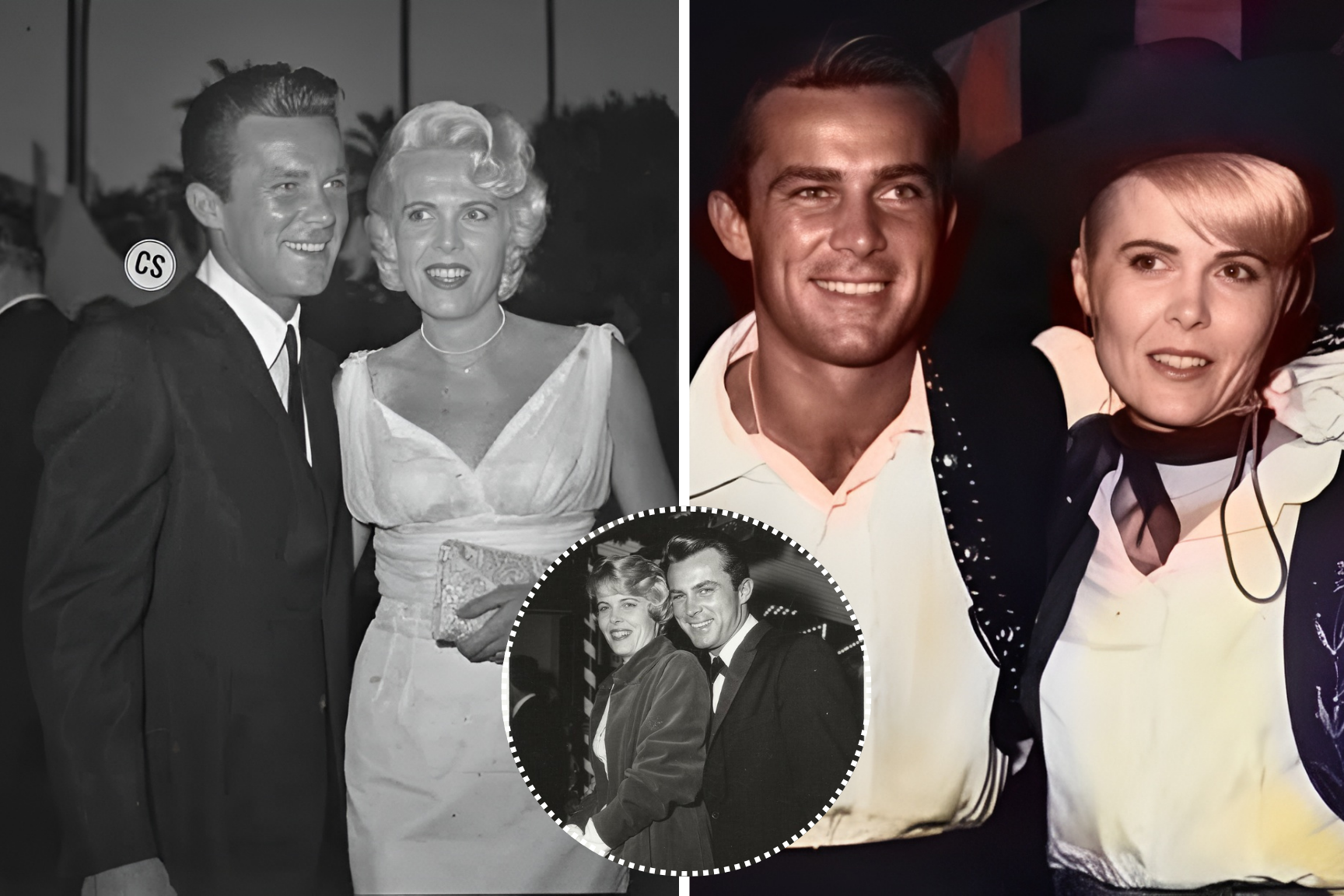
Winnetka sits on the North Shore of Lake Michigan like a carefully maintained version of the American dream—wide lawns, gracious homes, the quiet certainty of comfortable lives lived at a measured pace. It is the kind of place that tends to hold onto its people. Joan Kenlay left.
She was sixteen years old. He was nearly seventeen. And on a February day in 1952, Marjorie Joan Kenlay and a young man who had not yet settled on what to call himself made their way to Louisville, Kentucky, and got married.
No cameras. No fanfare. Decades before a television public would come to know her husband as one of the most physically commanding stars of the small screen—before Hawaiian Eye, before The Wild Wild West, before the stunt-heavy persona and the magazine-cover swagger—there was just this: two teenagers from Chicago, a courthouse in Kentucky, and whatever came next.
What came next lasted twenty-five years.
The Winnetka Teenager and the Milkman
The Girl From Winnetka
Her full name was Marjorie Joan Kenlay. She was born on April 17, 1935, in Chicago, Illinois, and her early years were tied—at least by address and association—to Winnetka, the affluent North Shore suburb that carries its own particular social weight. Her father was Floyd Marion Kenlay. Her mother appears in genealogical records as Marjorie Beth Kenlay, though that name surfaces in more than one form across different sources, a minor inconsistency that hints at how incomplete the documentary record remains.
What kind of house she grew up in, what school she attended, what she was expected to become—none of that survives in clean, verifiable form. Some biographical accounts have dressed up her background with appealing details: whispers of a convent education, suggestions of inherited wealth, the romantic image of a privileged girl who threw it all away for a working-class boy. Without a reliable school record or contemporaneous source to support those claims, they are decoration, not history.
The honest version of her early life is simpler. A girl from a Chicago-area family, raised in a suburb where order and expectation carried their own quiet gravity. A suburb that produced people who stayed, generally. And then, in the winter of 1952, a choice that cut against all of that.
Louisville, February 1952 — The Elopement
The groom’s name on the marriage license was not the one the public would eventually come to know. He had been born Conrad Robert Falk. He used his stepfather’s surname on the paperwork. And on a date recorded by detailed genealogical sources as February 27, 1952—though IMDb lists the date as February 23, a four-day discrepancy the historical record has never fully resolved—Joan Kenlay became Joan Kenlay Conrad, in Louisville, Kentucky, far enough from Chicago to constitute a deliberate departure.
She was sixteen. He was a few weeks shy of seventeen.
That chronology matters. It is easy to round the numbers upward, to say they were both already seventeen, and some accounts do exactly that. But the birth dates tell a different story, and the different story is more compelling precisely because it is truer: two people not yet old enough to vote, making a decision that would structure the next quarter-century of their lives.
No surviving account captures what their families said. No letters have surfaced. What remains is the date, the city, the license, and the plain, stubborn fact that the marriage held.
The Milk Truck, the Dock, and the Cost of Starting Early
There was no safety net built into what they were doing. Conrad—still in the process of building the public persona that would eventually replace his given name—took whatever work he could find. He drove a milk truck for Bowman Dairy in Chicago. He loaded freight on docks. These were not apprenticeships or romantic stepping stones framed as such in retrospect; they were the jobs available to a young man with a young wife and, before long, young children to support.
He sang in Chicago cabarets on the side. The gifts were present, even if the audience hadn’t materialized yet. A 1957 connection with actor Nick Adams would eventually open the door toward Hollywood work. But that was still years away, and years—when you are barely seventeen with a family to feed—are long.
The Apple TV biography of Robert Conrad notes plainly that he worked as a milk-truck driver and dock worker in the years following his marriage to Joan. Place that detail inside a timeline and it takes on specific weight. This is not a young man between adventures. This is a husband and soon-to-be father running the weekly arithmetic on what the family needs against what he can bring in. Stories circulate, as they always do around men who eventually become famous: that he lied about his age to get work, that he traded on a resemblance to James Dean outside movie theaters. Whether any of that is true, reliable sourcing hasn’t confirmed it. What the record does confirm is that the early years of the marriage were built on labor—unglamorous, necessary, continuous labor.
A Family Began Before the Fame
The first years of their marriage preceded everything that would later define Robert Conrad’s public identity. Hawaiian Eye was still the better part of a decade away. The gleaming, action-ready image—the swagger, the physical bravado, the television stardom that would eventually make his face recognizable to millions—had not yet been invented, because the market for it had not yet been created.
Joan lived inside that version of him. Whatever he became later, she knew the version that came before: the dairy driver, the dock worker, the cabaret singer, the young husband working through whatever the week demanded. That foundation gives the story its emotional texture. A marriage that begins before fame has a different quality than one that begins after it. The person who signs the license in Louisville in February 1952 is not the person the public will later recognize—and the woman who signs it alongside him is the only one who will ever fully understand the difference.
Riding the ‘Wild Wild West’ Wave
By the time Robert Conrad became a household name, his marriage to Joan was already a decade old. She had not married a star. She had married a young man from Chicago who, through a combination of drive, timing, and a crucial connection to Nick Adams, found his way to Hollywood. The stardom came later. Joan Kenlay was there for all of it—for the uncertainty before it, and for the bright, demanding years during it.
From Chicago Work to Television Recognition
The professional timeline accelerated sharply in the late 1950s. Conrad transitioned from cabarets and docks toward early television roles, and in 1959 he landed the part that first introduced him to a national audience: Tom Lopaka in Hawaiian Eye, the Warner Bros. detective series that ran through 1963. He was lean, athletic, photogenic in the precise way the small screen rewarded. Four seasons. A career, officially, underway.
Then came The Wild Wild West. From 1965 to 1969, Conrad starred as Secret Service agent James West in what became one of the era’s most stylistically distinctive programs—a hybrid of Western and spy thriller that relied heavily on his physicality and his genuine willingness to perform dangerous stunts himself. The show made him famous in the specific, durable way that only a long network run can manufacture. By the time it ended, his face was embedded in the American television consciousness in a way that would persist for decades.
Joan was his wife through all of it. Still married in 1965 when The Wild Wild West launched. Still married in 1969 when it wrapped. Still married for eight years after that.
What Was Joan Kenlay’s Life Like During Conrad’s Rise?
Here the historical record goes quieter, and the honest answer to that question is: we don’t fully know.
What the evidence establishes is the timeline. Their marriage continued through Hawaiian Eye, through The Wild Wild West, through the years when Conrad’s public profile moved from working actor to genuine star. Joan appears in the biographical accounts as wife, as mother, as the woman who was there—but her own voice, her own perspective on what those years felt like from the inside, has not surfaced in independently verifiable form.
Celebrity journalism in this era was built around the star. The spouse existed in the margin unless controversy pulled them into the frame. Joan Kenlay Conrad generated no such controversy. And so what the record preserves is her presence—confirmed, continuous—rather than her interiority.
That absence is not a failure of the story. It is part of it. A woman who spent her most visible years married to a television star, raising five children, and apparently not seeking her own separate public platform will leave a different kind of documentary trace than the man whose name appeared in the credits every week. Let that gap be what it is: an honest acknowledgment of what the sources were designed to capture, and what they were not.
The Children at the Center of Their Family Life
Joan and Robert Conrad had five children: Joan—known as Joanie—Shane, Christian, Christy, and Nancy. They arrived across the years of the marriage, growing up in a household that moved from Chicago’s working-class early years into the orbit of a Hollywood career that redefined the family’s public identity almost entirely through the father’s work.
The New York Times obituary for Robert Conrad, published in February 2020, anchors both the marriage’s start date and the five children from that union. It is the kind of primary source that stabilizes a family history when other documentation is scattered or inconsistent. Several of those children would eventually establish their own connections to entertainment—a story that belongs to a later chapter. What matters here is the simpler fact: five children, a sustained marriage, a family built across years of television prominence and the particular pressures that came with it.
Twenty-Five Years—and the 1977 Separation
Their marriage ended in 1977. That puts the duration at approximately twenty-five years—from the Louisville courthouse in February 1952 to a divorce that biographical accounts have generally characterized as amicable, though “amicable” in celebrity biography often functions as shorthand for a private process that neither party chose to explain publicly.
What the record gives us is the chronology, cleanly. They married young, raised five children together, remained together through the rise of a television career, and eventually separated. The private dynamics that led to the divorce are not documented in the sources that survive.
Robert Conrad married LaVelda Ione Fann in 1983, six years after the divorce from Joan. They had three children together. That second family belongs to a different branch of his biography—important for understanding the full arc of his life, but distinct from Joan’s chapter in it. Joan Kenlay was his first wife. The twenty-five years she shared with him represent the longest sustained relationship of his adult life.
The Data Briefing
| Profile detail | Documented or reported information |
| Full name | Marjorie Joan Kenlay |
| Married name | Joan Kenlay Conrad |
| Date of birth | April 17, 1935 |
| Birthplace | Chicago, Illinois |
| Reported hometown connection | Winnetka, Illinois |
| Date of death | January 6, 1998 |
| Place of death | Her home in Brentwood, Los Angeles, California |
| Age at death | 62 |
| Reported cause of death | Cancer, according to obituary-derived records |
| Husband | Actor Robert Conrad |
| Marriage date | February 27, 1952 (detailed Kenlay record); February 23 (IMDb) |
| Marriage duration | Approximately 25 years |
| Divorce | 1977 |
| Children | Five |
| Grandchildren | 11, according to the obituary reproduced by WikiTree |
Mothering a Hollywood Dynasty
Five children is not a footnote. It is a life’s work running parallel to everything else—the marriage, the decade-long television prominence, the eventual divorce, the two decades that followed. Joan Kenlay raised a family during the years when the definition of their household was being rewritten in TV Guide listings and entertainment columns. Whatever she made of that, she made it largely out of public view.
Joan, Shane, Christian, Christy, and Nancy
The five children from Joan’s marriage to Robert Conrad deserve to be named clearly, because they are frequently conflated in passing references, online databases, and the blur of a celebrity family’s combined history with the three children Conrad later had with LaVelda Fann. These are not the same family. They require a different column.
| Child | Publicly reported connection |
| Joan “Joanie” Conrad | Reported to have worked as a television producer; professional credits warrant independent verification |
| Shane Conrad | Actor |
| Christian Conrad | Actor |
| Christy Conrad | One of the five children; no verified profession in current sourcing |
| Nancy Conrad | Actress |
The New York Times obituary for Robert Conrad is the anchor source for these names. Individual professional credits—specific roles, producer titles, particular productions—require verification through trade records or screen credits before being stated as established fact.
Which of Robert Conrad’s Children Entered Entertainment?
Several of the five did move into the industry in some form. Shane Conrad has acting credits. Christian Conrad has acting credits. Nancy Conrad is reported to have pursued an acting career. Joan “Joanie” Conrad is associated with television production work, though confirming the specific nature and scope of that work requires going beyond the biographical summaries that circulate online without always being traced back to a primary source.
What none of that proves—and this distinction matters—is that Joan Kenlay directed, shaped, or managed their professional paths. The fact that children of a television star pursued entertainment careers is not, by itself, evidence of a parent’s professional influence. It may reflect proximity to the industry, inherited instinct, or simply the natural pull of growing up in a household where the entertainment world was ordinary dinner-table conversation. The evidence does not specify which.
The Family Branch That Began With Joan
Conrad’s second marriage, to LaVelda Fann in 1983, produced three more children: Kaja, Camille, and Chelsea. Those three belong to a separate chapter of his biography—one that began after his first marriage had already been over for six years. The distinction is worth making explicit, precisely because it tends to get blurred. When obituaries and profiles count Conrad’s children, they sometimes arrive at a total of eight without pausing to separate the two families. Joan Kenlay was the mother of five of those children. LaVelda Fann was the mother of three. That is not a minor bookkeeping correction. It is the difference between correctly identifying a woman’s place in a family history and absorbing her into a generic count.
What Her Children’s Careers Reveal—and What They Do Not
Some of Joan’s children built careers connected to entertainment. That is real, and it is worth noting. What it reveals about Joan herself is considerably less certain.
A mother whose children enter her husband’s professional world might have encouraged them, introduced them to the right people, quietly shaped their ambitions in ways that never made the trades. Or she might have watched it unfold with something closer to detachment, neither facilitating nor discouraging. The sources don’t establish which, and the responsible account doesn’t pretend otherwise.
What can be said without overreaching: Joan Kenlay raised five people, some of whom made their own mark on the industry that their father’s name made accessible. The family she built is part of the historical record. Her role in shaping what her children made of themselves is, at present, not.
Setting the Record Straight: A Legacy of Quiet Dignity
Here is where the internet tends to get Joan Kenlay wrong—not through malice, but through the casual carelessness of information that travels without being updated. Search her name in 2026 and you may still encounter snippets that imply she is alive: currently residing in Winnetka, or perhaps Los Angeles, her story still unfolding somewhere. It is not. Joan Kenlay Conrad died on January 6, 1998. She was 62 years old. Any source—blog post, celebrity database entry, aggregated biography—that presents her as a living person is simply incorrect, and the persistence of that error in the age of easily searchable records is itself a small injustice to a woman whose life deserves an accurate account.
Is Joan Kenlay Still Alive?
No. She is not.
Joan Kenlay Conrad died on January 6, 1998, at her home in Brentwood, Los Angeles, California. She was 62 years old. Obituary-derived genealogical records—including the WikiTree entry for Marjorie Joan Kenlay Conrad and the Find a Grave memorial in her name—both place her death in Brentwood on that date. The reported cause of death is cancer, though that attribution comes from obituary-derived records rather than a primary death certificate independently confirmed for publication, and should be treated accordingly.
To state this plainly for any reader who has arrived here with lingering uncertainty: in 2026, Joan Kenlay would be 91 years old if she had lived. She did not live to 91. She died twenty-eight years ago. Any online source presenting her as a current resident of Winnetka, Los Angeles, or anywhere else is wrong—if it is referring to the Joan Kenlay who married Robert Conrad in 1952 and spent twenty-five years building a family with him. The confusion may be innocent; names repeat across generations, and a younger relative might share the same one. But as a matter of biographical record, the woman at the center of this story has been gone since the final years of the twentieth century.
When Did Robert Conrad Marry Joan Kenlay?
Robert Conrad married Joan Kenlay in February 1952, in Louisville, Kentucky. The detailed Kenlay genealogical record gives the specific date as February 27. IMDb gives February 23. The four-day discrepancy has not been resolved by a primary record—a marriage license image, a contemporaneous newspaper notice—that has surfaced in publicly available sources, which means that any responsible biography should acknowledge both dates rather than selecting one arbitrarily and presenting it as settled.
What is beyond dispute: they married before Conrad’s acting career had generated any public profile. He was not yet a television star. The marriage preceded the fame entirely, which is precisely why Joan Kenlay’s story is worth telling on its own terms rather than as a footnote to his.
How Long Were Joan Kenlay and Robert Conrad Married?
Approximately twenty-five years. The marriage began in February 1952 and ended in divorce in 1977. Biographical accounts characterize the separation as amicable—that word appears across several sources—but the private reasons for the divorce, the conversations that preceded it, the shape of their relationship in its final years, are not part of the documented record.
Twenty-five years is a long time under any circumstances. Inside a Hollywood career carrying the specific pressures Conrad’s work entailed—extended production schedules, stunt work with real physical risk, a public persona that had to be maintained separately from whatever was happening at home—it is longer still.
How Many Children Did Joan Kenlay Have?
Joan Kenlay and Robert Conrad had five children together: Joan, Shane, Christian, Christy, and Nancy. These five should not be counted alongside the three children—Kaja, Camille, and Chelsea—that Conrad had with his second wife, LaVelda Fann. Those are two distinct family branches from two separate marriages. Joan Kenlay was the mother of five. That is the complete count of her children.
What Was Joan Kenlay’s Cause of Death?
Obituary-derived records report that she died of cancer. That attribution appears in the WikiTree record for Marjorie Joan Kenlay Conrad and in associated genealogical documentation. Confirming it against a contemporary obituary or a primary death record would establish it more firmly; on the basis of sources currently available, it is a reported rather than independently verified cause of death.
She was 62 when she died—twenty-one years after her divorce from Conrad, and twenty-two years before Conrad himself passed away in February 2020. They had been out of each other’s lives for more than two decades by the time she died.
Why Is So Little Known About Joan Kenlay?
The short answer is that the historical record preserved the career, not the marriage.
Television journalism in the 1960s and 1970s was built around the star—the actor, the role, the story the network wanted audiences to absorb. A wife who was not embroiled in controversy and who did not pursue her own separate public profile would not have generated the kind of contemporaneous press coverage that later researchers can use as source material. Joan Kenlay did not grant the interviews that would have preserved her perspective. She did not write a memoir. She did not become the subject of sustained biographical interest captured in real time.
She existed, as many people close to famous figures exist, at the edge of the frame. Visible enough to be confirmed. Not prominent enough, in the media culture of her era, to be interviewed about her own experience of the life she was living.
That is not the same as saying she chose obscurity, or that she was passive in the face of her own existence. It simply means that what the sources preserve about her is what those sources were designed to capture: her husband’s career, her marriage’s dates, her family’s names. The rest—her private thoughts, her ambitions, what she made of the strange decades during which her husband became famous and then her marriage ended and then she lived, privately, for another twenty-one years—is not in the record. And the honest account says so, rather than inventing what isn’t there.
A Legacy That Does Not Need a Hollywood Myth
Return to Winnetka for a moment. The ordered lawns, the social expectations, the comfortable certainty of a North Shore suburb that tends to produce people who stay rather than people who leave. Joan Kenlay left. She was sixteen years old, she married a young man who didn’t yet have the name he would eventually make famous, and she committed herself to an uncertain future with what the chronology suggests was complete resolve.
The marriage lasted twenty-five years. Five children arrived and grew up and, in several cases, found their own footing in the entertainment world their father’s career had made accessible. The divorce came in 1977. And then Joan Kenlay Conrad lived another twenty-one years—quietly, privately, in Brentwood—until her death in January 1998, at the age of 62.
None of that requires a myth to be meaningful. She was not an heiress who sacrificed a fortune for love—or at least, the evidence doesn’t support that framing. She was not a hidden architect of her husband’s success. She was not a tragic figure erased by proximity to fame, nor a triumphant one who emerged from it fully transformed. She was a woman who made a significant choice at sixteen, lived inside its consequences for a quarter-century, and then spent two more decades living her own life on terms the public record was not designed to document.
The record is partial. The gaps are real. But the outline of a life—a distinct, specific, irreducible life—is visible in the evidence that survives, if you read it honestly rather than through the lens of what you wish it confirmed. Joan Kenlay was the subject of her own story. She was also the object of someone else’s fame. Those two things are not the same, and the best any account of her can do is try, carefully, to keep them separate.